
Is Tubidy legal?
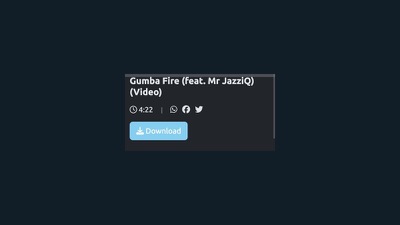
- Tubidy is a search service: it finds music and videos that are already online and prepares a file when you tap Download.
- Whether a particular download is lawful depends on the track, the permission its rights holder has given and the law where you live.
- Tracks the artist offers for free, or music under a licence that allows copying, can be saved within that licence's terms.
- Do not share, sell or re-upload protected songs, and report content you own through the copyright page.
This guide is general information about copyright, not legal advice. For a specific situation, ask a qualified lawyer.
On this page7 sections
Search Tubidy for songs, artists or music videos
Permission and Licensing
Songs and music videos are protected by copyright. The rights usually belong to the songwriter and to the owner of the recording, often a record label. In South Africa, copyright is governed mainly by the Copyright Act 98 of 1978, which gives the owner the right to decide who may copy, publish or share a work.
A song being easy to find online does not mean its owner has allowed everyone to copy it. Permission to download usually comes in one of these ways:
- The artist or label offers the track as a free download.
- The track has a licence, such as a Creative Commons licence, that allows copying on stated terms.
- You bought or licensed the music from a store or service whose terms allow a download.
The Copyright Act includes limited exceptions, known as fair dealing, for purposes such as private study, research and criticism. They are narrow and depend on the circumstances, so they should not be read as a general permission to copy commercial music.
What Tubidy Does
Tubidy shows search results for music and videos found online. When you open a result and tap Download, it prepares the MP3 or MP4 formats available for that result. The site's Disclaimer states that it does not host content on its own servers.
Not hosting a file does not, on its own, decide whether a particular download is allowed. That still depends on the permission for that track, so the checks in this guide apply whichever site you use.
Your Own or Authorised Content
The clearest cases are files you have the right to copy:
- Your own recordings, or recordings you made with permission.
- Tracks an artist or label gives away on their own page or channel.
- Music under a licence that allows downloads, used within its terms.
- Recordings and songs whose copyright has expired.
Using music in a video, podcast, advert or event is a separate question. You usually need a licence for that use, even if you can listen to the song for free. The free music guide explains how Creative Commons licences work.
Sharing and Redistribution
Most copyright problems come from what happens after a download:
- Do not upload protected songs to other websites, groups or file-sharing services.
- Do not sell copies or use protected music in commercial projects without a licence.
- Playing music in a shop, restaurant or at an event usually needs a public performance licence. In South Africa these are issued by organisations such as SAMRO and SAMPRA.
- Keep downloads for your own listening unless the track's licence allows more.
Rights holders can take action against copyright infringement. If you are unsure whether you may use a song, ask the rights holder or choose music with a clear licence.
Content Removal Requests
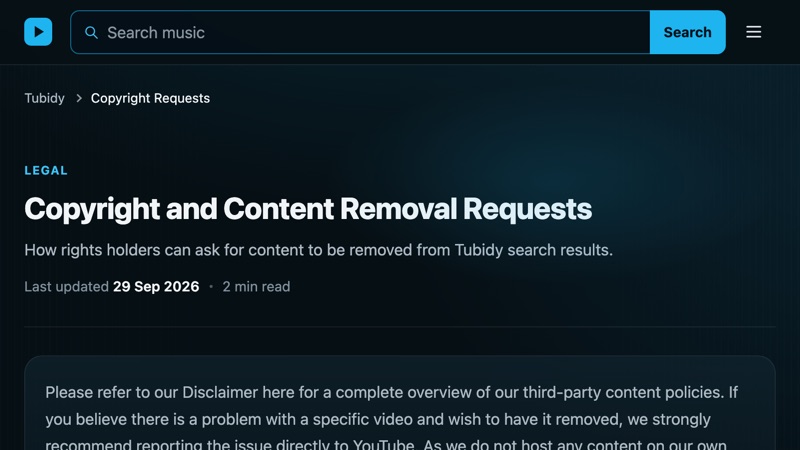
If you own the rights to a song or video and want it removed from Tubidy search results, send a notice through the copyright and content removal page. That page lists what a notice should include and where to send it.
In South Africa, section 77 of the Electronic Communications and Transactions Act 25 of 2002 sets out a take-down notice procedure for online service providers. The Terms of Use explain the rules for using the site, and the safety guide covers adverts and file types.
Copyright Questions
Is Tubidy legal to use?
Tubidy is a search service. Whether a download is lawful depends on the track and the permission its rights holder has given, not on the site alone. Music offered for free by the artist, or under a licence that allows copying, can be saved within the licence's terms.
Is personal use always allowed?
No. The Copyright Act has limited fair dealing exceptions, but they are narrow and depend on the circumstances. They are not a general permission to copy commercial music.
Can I share songs I downloaded?
Not protected songs. Uploading, sending or selling copies needs the rights holder's permission. Tracks under a licence that allows sharing can be shared within its terms.
How do I report a song that uses my music?
Send a notice through the copyright and content removal page with the address of the Tubidy page and details of the work you own.